
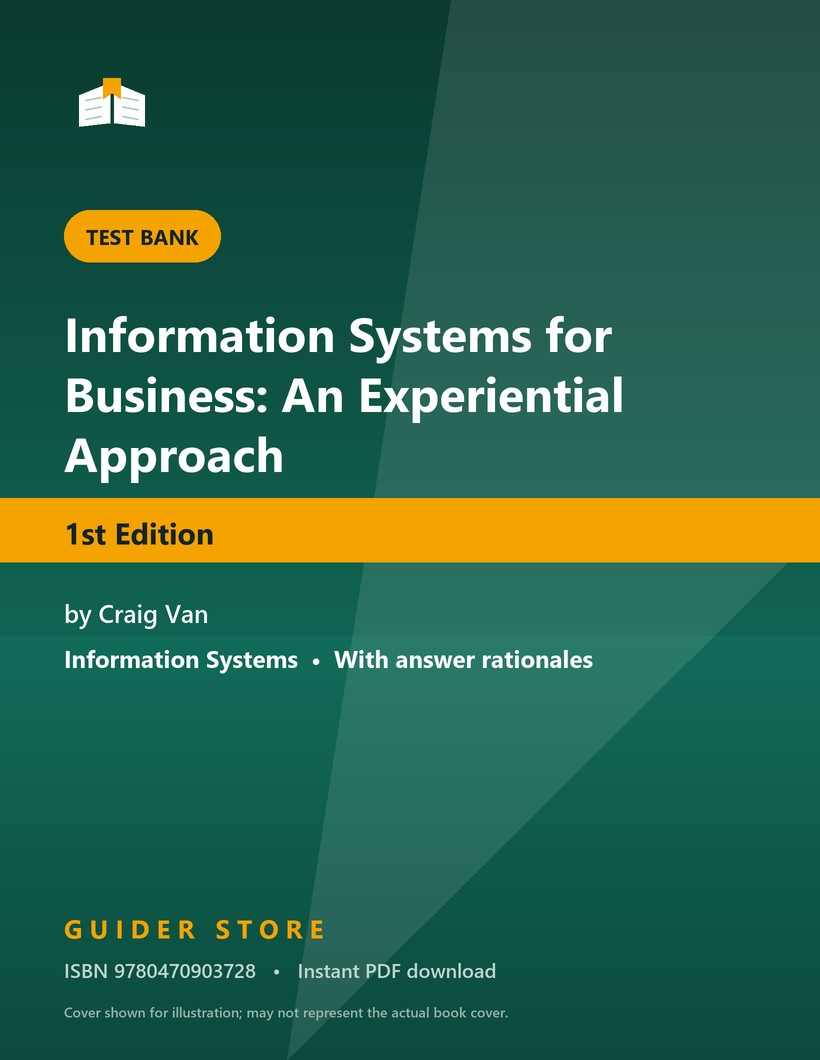



Information Systems for Business: An Experiential Approach, 1st Edition is built on the belief that you understand a system by building something with it, which is why the course usually runs a spreadsheet or database project alongside the reading. The written assessment is where that approach catches people out. Having produced a working query is not the same as being able to explain why a normalized design prevents an update anomaly, and the exam asks for the second thing while the lab rewarded the first.
Why this test bank helps
Hands-on courses leave a particular gap: procedural knowledge without the language to justify it. The rationale under each question here supplies that language, connecting what you did in the lab to the principle it demonstrated, so you can say why a foreign key enforces integrity, why a pivot table answers a different question than a filter, and why an unmodelled process defeats a well-built system. Reading those explanations turns practical competence into something an exam can credit.
What’s inside
- Questions that follow the book’s chapter and project sequence, so lab work and revision reinforce each other.
- Multiple choice, true/false and applied items, including short scenarios drawn from spreadsheet and database work.
- A written explanation on every item, linking the answer back to the principle the exercise was teaching.
- Attention to data modelling and process analysis, the two areas experiential courses examine most closely.
- One organized PDF, downloadable as soon as your checkout completes.
Topics covered
- Information systems and business value — what a system is expected to deliver and how that return is argued for.
- Business processes and process modelling — mapping a process, spotting handoffs and identifying where a system should intervene.
- Relational database design — entities, keys, relationships, normalization and the anomalies it exists to prevent.
- Querying and reporting — retrieving data to answer a defined business question rather than to display everything available.
- Spreadsheet modelling — building a decision model, testing assumptions and presenting the result honestly.
- Networks, infrastructure and cloud services — what an organization runs itself and what it rents, and why.
- Digital business and ecommerce — online business models, digital channels and the data they produce.
- Security, privacy and project delivery — controls, ethical use of data, and managing a systems project to completion.
Who it’s for
Undergraduates on an experiential or project-based introduction to business information systems, students combining a technology unit with spreadsheet and database labs, and anyone who needs the written theory to catch up with their practical work.
How to use it (the right way)
After each lab, write two sentences explaining why what you built works, because that sentence is what the exam is asking for. Then work a block of questions closed-book, mark every item you answered from habit rather than from understanding, and read those explanations carefully. This is a study aid, to be used in line with your institution’s academic-integrity policy for revision and self-assessment, and never carried into a graded assessment.
Sample question (shows the format — your download contains the full set)
Q. A single table stores every order together with the customer’s address repeated on each row. A customer moves, and only some of that customer’s rows are updated. What is this an example of?
- A. An insertion anomaly
- B. An update anomaly
- C. A deletion anomaly
- D. A violation of referential integrity
Answer: B. The fact is stored many times, so a change has to be applied many times, and a partial change leaves the table contradicting itself. That is the update anomaly, and splitting customers into their own table removes it by storing the address once. A would describe being unable to record a customer who has not yet placed an order. C would describe losing customer details when the last order is removed. D concerns a foreign key pointing at a row that does not exist, which is not what has happened here.
Edition & format
- Matches: Information Systems for Business: An Experiential Approach, 1st Edition (ISBN 9780470903728).
- Format: Digital PDF, available to download the moment checkout completes.
- Access: Lifetime — the file stays in your account to download again whenever you want.
Please confirm that the edition above matches the text and project workbook your course assigned before buying, since the exercises and chapter order differ between printings of this title.
Frequently asked questions
Is this the current edition? This set is prepared against the 1st Edition. If your course lists a later printing or a different experiential text, choose the matching listing instead of adapting this one.
How do I receive it? Delivery is instant. Once payment is confirmed the file is available on the confirmation screen and from your account area.
Do all the questions include rationales? Yes. Each item includes the reasoning behind the answer, including what makes the plausible distractors wrong.
Is using a test bank allowed? As a study aid it works like any other practice resource. Follow your institution’s academic-integrity policy, and never take the material into a graded assessment.
More practice for applied business technology courses is in Information Systems Test Banks.



Reviews
There are no reviews yet.